


As businesses navigate the complexities of digital marketing in 2025, a pressing question arises: Is SEO worth it? Despite the emergence of AI-driven search tools and evolving online behaviours, SEO continues to demonstrate substantial returns.
For instance, a high-quality SEO campaign can yield an average return on investment (ROI) of 748%, translating to approximately $7.48 for every dollar spent. This article explores the current value of SEO, examining its effectiveness and providing insights to help businesses make informed decisions about their digital marketing strategies in 2025.
What Is SEO?

SEO stands for Search Engine Optimization. It is the process of making a website better such that it shows higher on search engines like Google. Usually, people click on the top results when they search something online. SEO lets your page show in those top positions.
It covers things like choosing appropriate keywords, producing useful content, accelerating your website, and rendering it mobile-friendly. SEO also entails having other reliable websites link to yours.
Getting more people to visit your website without paying for advertising is SEO’s primary objective. Though it takes time, the outcomes are long-term. A well-optimized site can generate more leads, consistent traffic, and more sales.
Is SEO Worth It?

Yes, It is generally beneficial for businesses looking to improve their online presence to invest in Search Engine Optimisation (SEO).
This is the reason:
- Huge Search Volume: Google handles more than 8.5 billion searches daily, equivalent to 81,000 searches per second.
- User Behaviour: Search engines are the starting point for 68% of online experiences, underscoring the significance of appearing in search results.
- Cost-Effective Marketing: SEO leads are a cost-effective marketing strategy because their close rate is almost 15%, much higher than the 1.7% close rate for outbound leads.
- Long-Term Benefits: Although SEO results might not appear immediately, they usually last and bring in more traffic without constant work.
What Does SEO Include?
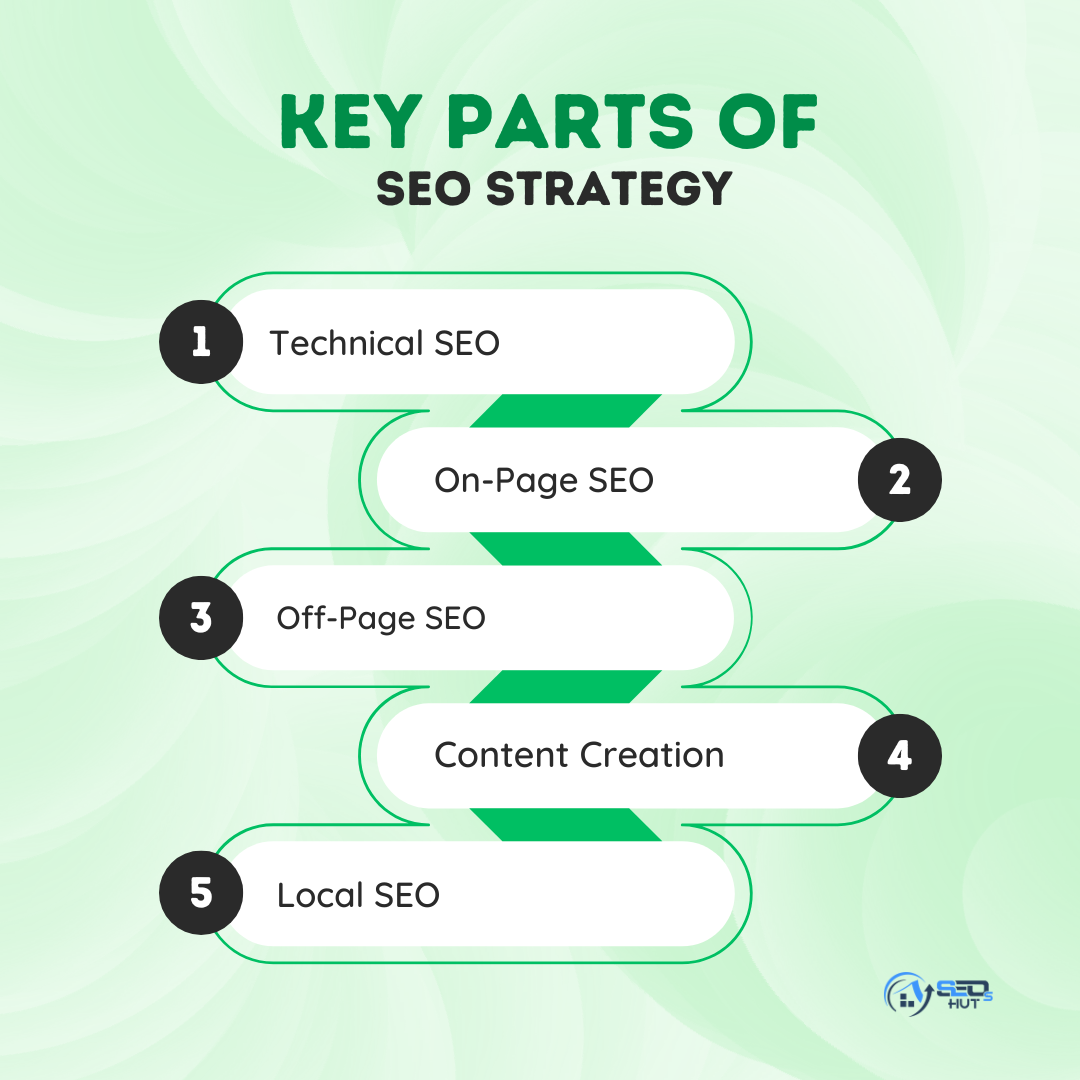
If you’ve ever wondered how websites show up on Google when you search for something, the answer is SEO – Search Engine Optimisation. It’s not just one thing; SEO is made up of different parts that work together to help people find your business online. Let’s break it down in a simple way.
1. Technical SEO
This is the behind-the-scenes work that makes your website easy for search engines to read and understand. Think of it like giving your site a health check. It covers things like how fast your pages load, whether your site works properly on mobiles, and if your website has a secure connection (HTTPS). It also includes organising your site in a clear way so both people and Google can move around it easily. You might not see these changes, but they make a big difference.
2. On-Page SEO
This part is all about what’s actually on your website. It includes using the right keywords (the words people type into search engines), writing helpful content, and making sure your page titles and headings are clear and interesting. Adding links between your own pages also helps visitors explore more. On-page SEO makes your site easier to understand – not just for search engines, but for your visitors too.
3. Off-Page SEO
This is what happens outside your website that helps improve your online reputation. One big part of this is getting backlinks – links from other websites that point to yours. It’s a sign that others trust your content. You can also improve off-page SEO through social media shares, guest blogging, and even just being talked about online. The more respected your site looks from the outside, the better it performs in search results.
4. Content Creation
Content is at the heart of SEO. This means blog posts, videos, infographics, and anything else that gives value to your audience. Fresh, helpful content keeps your site active and gives people a reason to keep coming back. Plus, good content naturally attracts links and shares – which improves your SEO even more.
5. Local SEO
If your business serves a local area, like a shop or a clinic, then local SEO is essential. This includes things like setting up your Google Business Profile, getting listed in online directories, and collecting customer reviews. It helps your business appear in searches like “coffee shop near me” or “local dentist”.
User Experience and Website Optimisation Benefits Of SEO
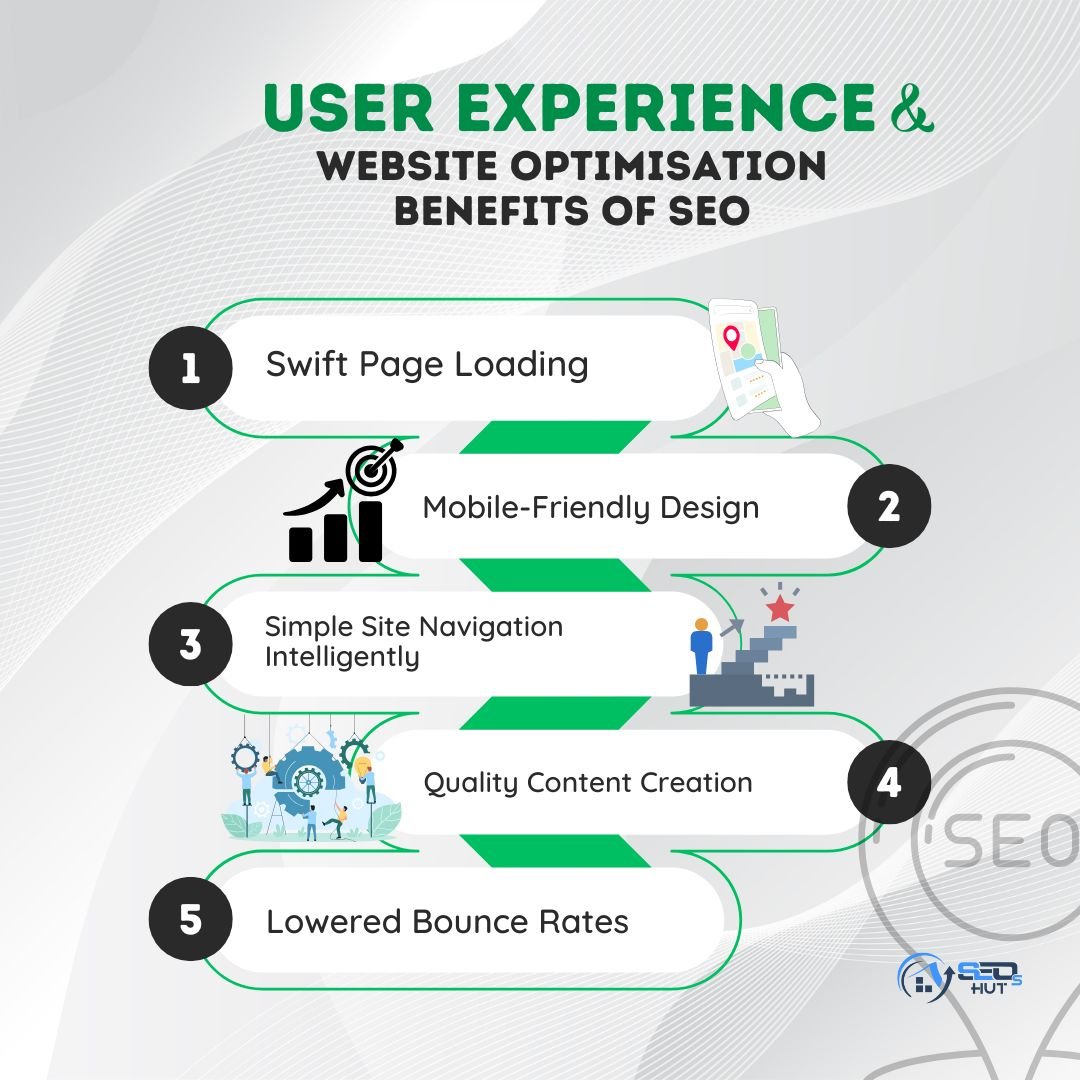
By concentrating on essential elements of SEO, companies can provide their guests with more engaging and effective surroundings. Seven main advantages of including SEO with user experience are listed below:
1. Swift Page Loading
Retaining visitors depends critically on the speed at which a page loads. Pages loaded in two seconds have an average bounce rate of 9%, according to research; load times of five seconds cause this average bounce rate to 38%. Faster page loads are achieved with SEO methods, including compressing images, browser caching, and cutting pointless code. Not only does a fast-loading website satisfy users, but it also conforms to search engines’ speed preferences, thus improving rankings. Standard
2. Mobile-Friendly Design
Since more than 60% of Google searches come from mobile devices, a website must be responsive on several screen sizes. SEO techniques support designs that fit perfectly on several devices, offering a consistent and user-friendly interface. Google’s mobile-first indexing prioritises mobile-optimised websites; thus, responsiveness is crucial for search engine visibility.
3. Simple Site Navigation Intelligently
A well-organised website lets users quickly find information. SEO calls for logical content organisation, menu use, and application of internal linking techniques. These improvements lower bounce rates and boost user time on the site, indicating to search engines the site’s value.
4. Quality Content Creation
SEO stresses creating pertinent, engaging, educational material catered to target markets. Good material builds trust, answers users’ questions, and motivates more extended site visits. It also raises the possibility of getting backlinks and improving search results.
5. Lowered Bounce Rates
Fast load times, mobile optimisation, easy navigation, and quality material guarantee that users remain interested. Visitors are less likely to depart early when they quickly and effectively find what they seek. Reduced bounce rates show search engines that the site offers value, influencing rankings.
6. Engaging Multimedia Integration
Including images, videos, and infographics helps increase interest in the material. SEO techniques often involve optimising these components to guarantee they don’t slow down the site, offering an enhanced user experience without sacrificing performance.
7. Easy Accessible Content for Every User
Using descriptive alt texts for images and making sure content is readable help improve the site’s accessibility to people with disabilities through SEO methods. An easily navigable website shows inclusiveness and serves a larger audience.
SEO Benefits for Business Growth and Visibility
Search Engine Optimisation (SEO) is no longer just a technical trick but a core business tool that directly supports growth, trust, and long-term visibility. Below are seven practical ways SEO drives business success, backed by real-world data.
1. Brings More Visitors Without Paying for Ads
Most people use Google or similar platforms to find products or services. In fact, over 93% of online experiences start with a search engine. When your website appears on the first page, especially in the top three results, it naturally gets more visitors. According to a Backlinko study, the top Google result grabs 27.6% of all clicks. Unlike paid advertising, where you pay for every visitor, SEO can bring people to your site without paying per click. Once your website is set up well and your content matches what people are looking for, it works quietly in the background to increase daily traffic.
2. Builds Trust With Your Audience
People tend to trust what they find at the top of Google. When your business regularly shows up in these top spots, it gives the impression that you’re reliable and well-established. According to Search Engine Journal, 75% of users never scroll past the first page. So, being seen there helps your brand stand out. When potential customers see your name repeatedly, trust starts to build even before they visit your site. Over time, this trust leads to more people picking your brand over others they’ve never heard of.
3. Keeps Costs Low While Results Add Up
SEO is not a quick fix, but it pays off over time. Traditional ads and social media promotions cost money for every click or impression. Once the budget is gone, so is the traffic. On the other hand, SEO gives long-lasting results. By working on your content, website structure, and keywords, you’re setting up a system that keeps working for you. Businesses that rely on SEO often spend less on paid marketing because their website brings in enough traffic. It’s like building a solid foundation that doesn’t need daily spending to keep standing.
4. Connects You With People Ready to Take Action
Unlike cold emails or random social media ads, SEO brings in people already looking for what you offer. These visitors come with intention. HubSpot says SEO leads are eight times more likely to become paying customers than outbound leads. This is because SEO targets people based on what they are searching for now. When your website gives them the answers or services they need, they are likelier to get in touch or purchase.
5. Helps You Outperform Your Competitors
Think of search rankings like shelf space in a store. Being at the top means more people notice you first. If your business shows up and your competitor doesn’t, you are more likely to win that customer. According to a study by Chitika, 91.5% of traffic goes to the websites on the first page. That leaves very little chance for those on the second or third page. So, working on your SEO gives you a clear advantage. Even if your competitors have bigger budgets, showing up first in a Google search levels the playing field.
6. Supports a Better Website Experience
Google doesn’t just look at keywords. It also looks at how user-friendly your site is. SEO best practices often lead to better structure, faster loading, and mobile readiness. All of these factors matter to your visitors. People leave if your website loads too slowly or is hard to use on a phone. According to Portent, the first five seconds of page load time impact conversion rates the most. A fast, easy-to-navigate site keeps people around longer and encourages them to explore what you offer.
7. Lays the Groundwork for Long-Term Growth
Unlike a one-time promotion, SEO is a strategy that keeps building. The more helpful content you publish, the more keywords you can find. Over time, your digital presence grows, and your brand becomes more recognised. SEO efforts can significantly bring in steady traffic for years if you regularly update your site with content people care about. This consistency supports long-term goals like brand awareness, loyal customer relationships, and new market expansion.
How To Properly Implement SEO For Businesses?

A well-structured SEO strategy improves search engine rankings and aligns with business objectives to drive growth. Below are seven essential steps to properly implement SEO for your business:
1. Align SEO with Business Goals and Define KPIs
Begin by understanding your business objectives and determining how SEO can support them. Conduct an SEO audit to assess your online presence and identify areas for improvement. Establish KPIs to measure the success of your SEO efforts, such as website traffic, lead generation, and conversion rates. This alignment ensures that your SEO strategy contributes directly to your business goals.
2. Conduct Comprehensive Keyword Research
Identify the terms and phrases potential customers use when searching for your products or services. Utilise tools like Google Keyword Planner to discover relevant keywords with substantial search volumes and manageable competition. Incorporate these keywords into your website’s content to enhance visibility in search engine results pages (SERPs).
3. Optimise On-Page Elements
Ensure that each page of your website is optimised for both users and search engines. This includes crafting compelling title tags, meta descriptions, and headers incorporating target keywords. Additionally, optimise images with descriptive alt text and ensure concise and descriptive URLs. These practices enhance user experience and facilitate search engines’ better indexing.
4. Focus on High-Quality Content Creation
Develop informative and engaging content that addresses the needs and interests of your target audience. High-quality content encourages visitors to spend more time on your site and positions your business as an authority in your industry. Regularly updating your website with fresh content also signals to search engines that your site is active and relevant.
5. Build a Strong Backlink Profile
Acquire backlinks from reputable and relevant websites to enhance your site’s authority. Engage in guest blogging, collaborate with industry influencers, and create shareable content to attract quality backlinks. A robust backlink profile signals to search engines that your site is trustworthy and valuable, which can positively impact your rankings.
6. Ensure Technical SEO Excellence
Address technical aspects of your website to ensure optimal performance. This includes improving site speed, ensuring mobile-friendliness, and creating an XML sitemap. Regularly monitor and fix crawl errors, broken links, and duplicate content issues to maintain a healthy website structure that search engines can easily navigate.
7. Leverage Local SEO Strategies
For businesses targeting local customers, optimising for local search is vital. Create and verify your Google My Business listing, ensure your business’s name, address, and phone number (NAP) are consistent across all platforms, and encourage satisfied customers to leave positive reviews. These actions enhance your visibility in local search results and attract nearby customers.
Common Questions and Objections About SEO

Search Engine Optimisation (SEO) can feel confusing or uncertain to many business owners, especially those just starting with digital marketing. Let’s break down three of people’s most common questions and doubts about SEO and give clear, honest answers.
1. Is SEO Worth the Investment?
This is the first thing people ask. SEO takes time, effort, and sometimes money, so it’s fair to wonder if it’s worth it.
The truth is that SEO is one of the most cost-effective ways to get visitors to your website. BrightEdge says more than 50 per cent of all website traffic comes from organic search. That means people find businesses just by typing what they need into Google.
Once your site is ranked well, you can keep getting visitors for free. SEO works in the background, unlike paid ads, which you pay for every click. So yes, SEO is worth it if you’re aiming for steady, long-term growth.
2. Why Does SEO Take So Long to Show Results?
Another common question is about timing. Many people want results fast, mainly when they are used to seeing quick results from ads.
SEO works differently. It takes time because search engines need to notice your site, understand what it’s about, and trust that it’s helpful to users. This means writing quality content, using proper keywords, fixing technical issues, and building links from other trusted websites.
Think of SEO as building a house. You don’t see the entire building on day one. But once it’s built properly, it stands strong for years. The results are slow to come, but they last much longer.
3. Why Not Just Use Ads Instead of SEO?
Some business owners think ads are better because they deliver fast results. It’s true that paid ads can drive traffic quickly, but when you stop paying, the traffic disappears. SEO works differently. Once your website ranks on search engines, it continues to attract visitors without daily spending.
Relying only on ads is like renting a shop—when rent stops, the shop closes. SEO is like owning the property. It takes effort upfront, but the benefits last much longer. Also, people tend to trust organic search results more than ads. Using both SEO and ads together is ideal, but ignoring SEO means missing out on long-term, stable growth without repeated costs.
4. Isn’t SEO Too Complex for Small Businesses?
Many small business owners worry that only big companies can manage SEO. They think it’s too technical, too expensive, or not worth the time.
However, the truth is that SEO can work exceptionally well for small businesses, especially at the local level. According to BrightLocal, 98% of people used the internet to find a local business last year. Another study from LocalIQ shows that 40% of local SEO campaigns bring a return of 500% or more.
You don’t need to master every SEO trick. A fast, mobile-friendly website, adding your business to Google Maps, and using the right keywords in your content can make a noticeable difference. It’s not about being perfect. It’s about being present when people in your area are searching.
5. Isn’t Social Media Enough to Grow Online?
Some business owners believe that posting on Facebook or Instagram is all they need. While social media is great for engagement and brand personality, it doesn’t replace SEO.
Search Engine Journal reports that search engines drive 1,000% more website traffic than organic social media. That’s not a small gap. Also, 68% of online experiences begin with a search, not a scroll.
Social media is about maintaining relationships with existing customers. SEO helps new people discover you when they need something. That’s the key difference. They work best when used together, not as replacements for each other.
6. What if I Invest in SEO and Nothing Happens?
This is probably the most common fear—and it’s fair. No one wants to spend time and money on something that doesn’t deliver. But SEO isn’t like paid ads where results appear in a day. It’s a long game.
According to Ahrefs, only 5.7% of pages rank in the top 10 of Google within one year. However, those that do often stay there for a long time. In another report, Page Optimiser Pro found that small businesses investing in SEO typically see a return of 400% within two years.
That might sound slow, but SEO builds momentum. Once your website is ranking and getting traffic, it keeps working even when you’re not actively promoting it. Ads stop the moment you stop paying, but SEO keeps going.
7. Isn’t SEO Too Expensive for a Small Budget?
Many small business owners worry that SEO is only for big-budget companies. The truth is that SEO can be scaled based on your resources, and even low-cost strategies can bring strong results over time.
A report by Databox found that 70% of small businesses spend less than £750 per month on SEO, yet many still see measurable growth in website traffic and lead generation. SEO costs are often lower than traditional ads or pay-per-click (PPC), which can quickly eat into your budget without long-term value.
What makes SEO powerful is its compounding effect. The content you write today can still bring traffic a year from now. So, instead of looking at SEO as a cost, it should be seen as a long-term investment that delivers steady returns.
8. Isn’t It Better to Focus on Paid Ads for Fast Results?
Paid ads on Google or social media can get your business in front of people quickly. But once your budget runs out, the visibility ends immediately. With SEO, the results take longer to show—but they also last longer.
According to the Search Engine Journal, SEO leads have a 14.6% close rate, while outbound methods like cold calls or print ads have a close rate of just 1.7%. That means the visitors who visit your site from Google searches are far more likely to become paying customers.
Also, Ahrefs found that only 2.6% of all clicks go to paid ads, while over 67% go to the top five organic search results. This shows that most people prefer to click on natural search results rather than sponsored links.
So yes, ads are useful for short bursts of traffic, but SEO brings more trust, better leads, and longer-term returns without the constant spending.
When Is the Perfect Time To Start With SEO?

The best time to start Search Engine Optimisation (SEO) is before launching your website. Integrating SEO strategies during the planning and development stages ensures your site is structured effectively, making it more accessible to search engines and users. This proactive approach can lead to faster indexing and better search rankings.
Starting SEO early allows you to conduct thorough keyword research, optimise site architecture, and create quality content tailored to your target audience. These steps enhance user experience and establish a solid foundation for your site’s long-term online visibility.
Delaying SEO until after your site is live can result in missed opportunities and may require significant restructuring later, which can be time-consuming and costly. Therefore, integrating SEO from the beginning is a strategic move that can substantially benefit your website’s performance and visibility.
Is Local SEO A Great Prospect For Small Businesses?

Local Search Engine Optimisation (SEO) is a crucial strategy for businesses aiming to attract nearby customers. Here are several reasons, supported by data and statistics, highlighting why local SEO is a valuable investment:
1. Local searches lead to fast results
One of the biggest advantages of local SEO is how quickly it brings real-world results. According to Google, 76% of people who search for something nearby on their phone visit a business within 24 hours. Even better, 28% of those visits lead to a purchase.
This proves that local searches often come from people who are ready to act. If your business appears in those results, you are in a strong position to attract serious customers. It is a direct and effective way to increase foot traffic and sales without spending too much on traditional marketing efforts.
2. “Near me” searches are growing fast
People now use search engines to find local options more than ever. The use of the phrase “near me” in search queries has grown massively. In fact, in the United States alone, there are over 800 million searches per month that include “near me” or similar terms. This trend is just as strong in the United Kingdom.
It clearly shows that consumers want quick, local solutions. If your business is properly optimised for local searches, you are much more likely to be discovered by people in your area who are actively looking for your products or services.
3. Reviews build trust and improve visibility
Online reviews are a powerful part of local SEO. Studies show that 76% of people regularly read reviews before choosing a local business. Most of them trust reviews as much as personal recommendations from friends or family. If your business has many good reviews, you are more likely to be chosen by potential customers.
Google also uses reviews as a factor when ranking local search results. This means positive feedback not only builds trust but can also improve your visibility online. Responding to reviews, even negative ones, shows professionalism and helps you stand out from the competition.
4. Local SEO gives small businesses an edge
Local SEO is one of the few marketing tools that truly helps smaller businesses compete with larger ones. You do not need a big budget to get noticed locally. A well-optimised Google Business Profile, accurate location details, and a few good reviews can go a long way.
Surprisingly, about 58% of businesses still do not invest in local SEO. This leaves a huge opportunity for others to get ahead. By simply showing up in local searches, your business can attract more foot traffic, phone calls, and enquiries from nearby customers who are ready to buy.
5. Mobile searches with local intent are powerful
Over 60% of all searches now come from mobile devices. Most of these mobile searches are looking for something local, like a nearby shop, restaurant, or service. If your business is not showing up in these results, you are missing out on customers who are ready to act immediately.
Local SEO helps make sure your address, opening hours, contact details, and directions are easy to find on mobile. This convenience plays a huge role in customer decisions. Being present in local mobile searches can turn online interest into real visits, especially for brick-and-mortar businesses.
How Much Does SEO Cost In 2025?
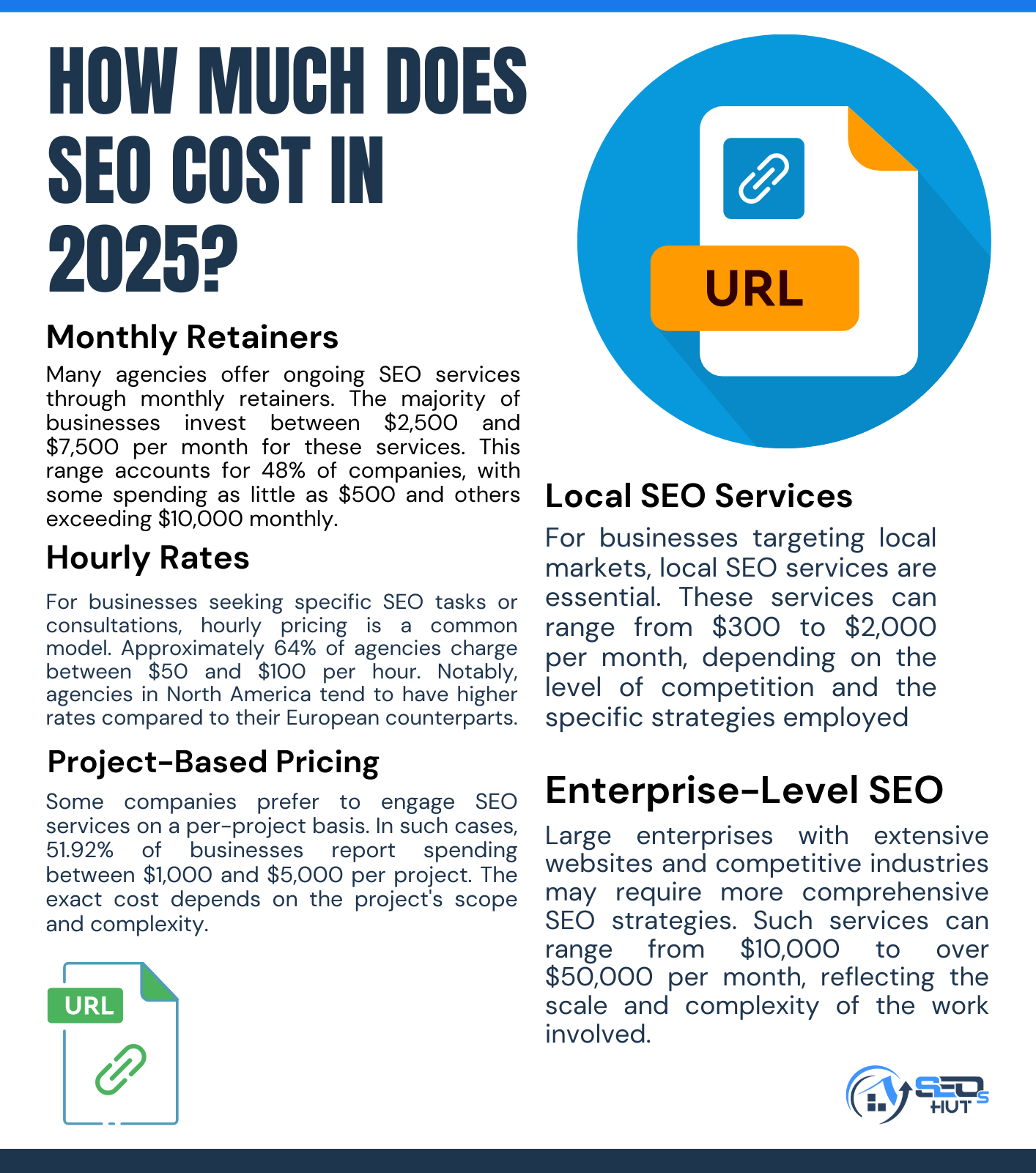
In 2025, the cost of Search Engine Optimisation (SEO) services varies significantly based on factors such as the provider’s expertise, the complexity of the project, and the specific needs of the business. On average, businesses can expect the following pricing structures:
Monthly Retainers: Many agencies offer ongoing SEO services through monthly retainers. The majority of businesses invest between $2,500 and $7,500 per month for these services. This range accounts for 48% of companies, with some spending as little as $500 and others exceeding $10,000 monthly.
Hourly Rates: For businesses seeking specific SEO tasks or consultations, hourly pricing is a common model. Approximately 64% of agencies charge between $50 and $100 per hour. Notably, agencies in North America tend to have higher rates compared to their European counterparts.
Project-Based Pricing: Some companies prefer to engage SEO services on a per-project basis. In such cases, 51.92% of businesses report spending between $1,000 and $5,000 per project. The exact cost depends on the project’s scope and complexity.
Local SEO Services: For businesses targeting local markets, local SEO services are essential. These services can range from $300 to $2,000 per month, depending on the level of competition and the specific strategies employed.
Enterprise-Level SEO: Large enterprises with extensive websites and competitive industries may require more comprehensive SEO strategies. Such services can range from $10,000 to over $50,000 per month, reflecting the scale and complexity of the work involved.
Finally, PPC vs Traditional Marketing Vs SEO: What Is The Best Option?
Search Engine Optimisation (SEO), Pay-Per- Click (PPC) advertising, and traditional marketing each have unique benefits when assessing marketing plans.
SEO is mostly concerned with improving a website’s natural search engine result visibility. This long-term, reasonably priced approach increases credibility and generates steady traffic. Results take time, but generally the long-term advantages exceed the initial outlay.
Placing paid ads at the top of search results gives PPC advertising instant visibility. For short, focused campaigns, it works well; but, since traffic stops when the budget runs out, it calls for ongoing financing.
Conventional marketing covers print, radio, and television commercials. Although it can be seen by a lot of people, it usually involves more expenses and lacks the exact targeting and quantifiable results provided by digital strategies.{{{
For steady development, SEO should be given top priority; PPC for immediate needs and conventional marketing for a larger audience should complement each other.